Background
Could synthetic biology offer a new way of approaching Polyendocrine Metabolic Ovarian Syndrome (PMOS)?
To answer this question, we first had to decide where our contribution could be most meaningful. PMOS is a complex and highly heterogeneous condition, with symptoms and priorities that vary between individuals and no single intervention can address every aspect of it. So we had to choose one target, and we set two criteria: it had to be biologically relevant, and it had to matter to the people living with PMOS. HyperandrogenismHigher than normal levels or effects of androgens, the male sex hormones such as testosterone. met both. In the literature and in patient stories, excess androgens are linked to visible symptoms such as acne and hirsutism. They also act on the ovarian and more broadly at the systemic level, creating a reinforcing cycle between endocrineThe endocrine system is responsible for the release and control of hormones in the body. imbalance and metabolic impairment (Teede et al., 2023; Helvaci & Yildiz, 2025). Hyperandrogenism therefore became the focus of our project and the starting point for our engineering.
The project begins with the people who spent years trying to have the complexity of their condition recognized. Their experiences remind us that developing a new solution is not only a question of whether it can work biologically. It must also respond to a real need and be described, tested and communicated with greater precision than the problem it is intended to address.
Polyendocrine Metabolic Ovarian Syndrome and Hyperandrogenism
Polyendocrine Metabolic Ovarian Syndrome (PMOS), formerly known as Polycystic Ovary Syndrome (PCOS), is one of the most common endocrine and metabolic disorders affecting women of reproductive age (World Health Organization, 2026).
The recent transition from the term PCOS to PMOS reflects an important conceptual shift in the field: the syndrome is no longer regarded primarily as a disorder of ovarian morphology, but rather as a systemic condition involving endocrine, metabolic, reproductive, dermatological, and psychological manifestations (Teede et al., 2026; Wang et al., 2023).
PMOS represents a major global health burden.
10-13% of women worldwide are affected, while up to 70% of cases may remain undiagnosed (World Health Organization, 2026).

And this burden often begins before a diagnosis is made.
Out of 1,385 women diagnosed with PMOS, 33.6% had waited more than two years for a diagnosis, and 47.1% had consulted at least three healthcare professionals (Gibson-Helm et al., 2017).
This diagnostic gap reflects both the heterogeneity of the syndrome and the historical under-recognition of women's endocrine and metabolic health conditions.
How is PMOS diagnosed?
According to the Rotterdam Criteria (Wang et al., 2023; Rotterdam Criteria, 2017) for a PMOS diagnosis, a woman need to meet 2 out of 3 of the following symptoms and other mimic conditions must be ruled out first:
Hyperandrogenism
Ovulatory Dysfunction
Polycystic Ovarian Morphology
More than a fertility condition, PMOS may increase risks of:
Heart disease
Type 2 diabetes

Fatty liver disease
Anxiety and depression

High blood pressure

Difficulty in conceiving

Symptoms can lead to a reduced quality of life!
Hyperandrogenism
Hyperandrogenism is a medical condition defined by an excess of androgen hormones, such as testosterone. Within this broader picture, hyperandrogenism is relevant to our project as it connects a measurable biological process with symptoms that can matter greatly to those affected. Diversity of PMOS means that reducing androgenic activity would address only part of the condition, and its value would ultimately need to be assessed through outcomes meaningful to patients.
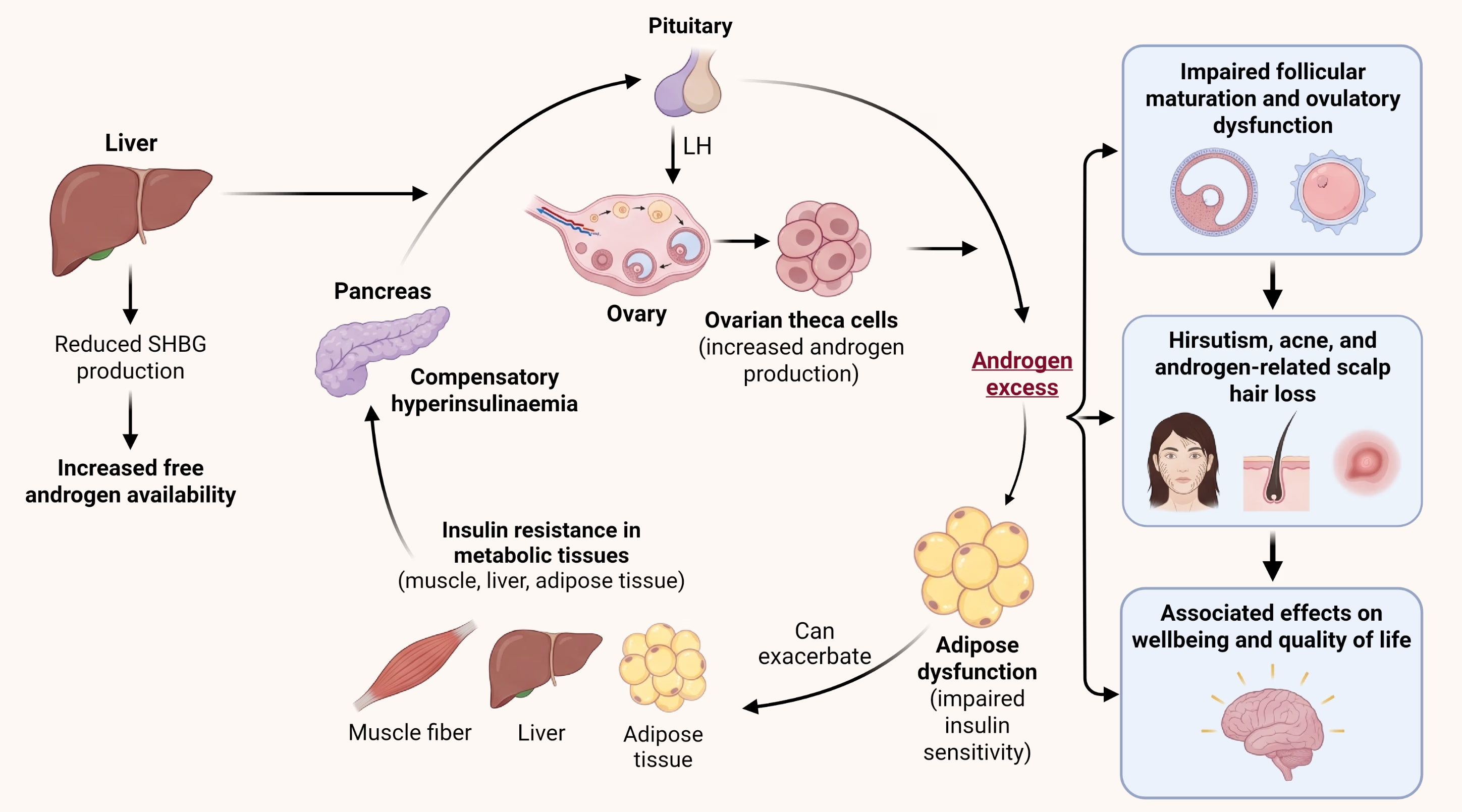
This particular feature of PMOS contributes directly to dermatological symptoms such as hirsutism, acne, and alopecia, but it also interferes with follicular development, ovulation, and endocrine homeostasis (Wang et al., 2023). At the ovarian level, excess androgens can impair normal folliculogenesisThe maturation of follicles, the small sacs in the ovary that each hold a developing egg., contributing to the accumulation of immature follicles and chronic anovulation. At the systemic level, hyperandrogenism is closely associated with insulin resistance and broader metabolic dysfunction, creating a reinforcing cycle between endocrine imbalance and metabolic impairment (Harrath et al., 2026). This interaction is central to the pathophysiologyHow a disease disrupts the body's normal functions. of PMOS: insulin resistance can increase ovarian androgen production and reduce sex hormone-binding globulinA blood protein that binds sex hormones and keeps them inactive while bound. (SHBG), increasing consequently the fraction of bioavailable androgensThe share of androgens not tightly bound to SHBG, which can still act on tissues.. In turn, elevated androgen levels may further contribute to adipose tissueBody fat tissue, which stores energy and releases hormones. dysfunction, inflammation, and metabolic dysregulation.
Existing Treatment Options
| Treatment | How it works | Role in PMOS and limitations |
|---|---|---|
| Combined oral contraceptive pills (COCs) | Suppress ovarian androgen production and increase SHBG, reducing free testosterone. | Common first-line pharmacological options for hirsutism and irregular cycles. The treatment is not compatible with pregnancy and suitability depends on individual contraindications and risks, including thrombosis. |
| Anti-androgens, e.g. Spironolactone, Flutamide, Finasteride. | Reduce androgen action in target tissues. Spironolactone blocks androgen receptors. | Used for persistent hirsutism, and/or when COCs are unsuitable or poorly tolerated. Effective contraception is needed because of risks to male fetal development, evidence is heterogeneous and mostly of low certainty. |
| Metformin | Improves metabolic function and insulin sensitivity and may reduce insulin driven androgen excess. | Primarily used for metabolic indications; it is not a first-line treatment for hirsutism alone. |
Current therapeutic strategies for PMOS are mainly symptom-oriented and depend on the patient’s clinical priorities, such as menstrual regulation, treatment of hyperandrogenic symptoms, fertility, or metabolic risk reduction. International guidelines recommend lifestyle interventions as a core component of management (Teede et al., 2023). Although these approaches can provide important benefits, they do not cure PMOS and were not designed to directly treat women with the syndrome. Moreover, recent evidence assessments have highlighted that major gaps remain regarding their long-term efficacy, safety, and impact on quality of life (SBU, n.d.).
Gut-Androgen Axis
In recent years, the gut microbiomeThe community of microbes, mostly bacteria, living in the gut, together with their genes. has emerged as a potential contributor to PMOS pathophysiology. The intestinal microbiota is increasingly recognized as an active metabolic and endocrine interface capable of influencing host energy metabolism, immune signaling, bile acidBile acids are made by the liver to digest fats; gut bacteria modify them, and they are then reabsorbed or lost. turnover, and steroid hormone homeostasisKeeping steroid hormone levels in balance.. Several studies have reported alterations in gut microbial diversityThe number of different microbial species in the gut, and how evenly they are represented. and composition in women with PMOS, and these changes have been associated with hyperandrogenism, insulin resistance, and inflammatory markers (Torres et al., 2018; Li et al., 2023; Gao et al., 2026).
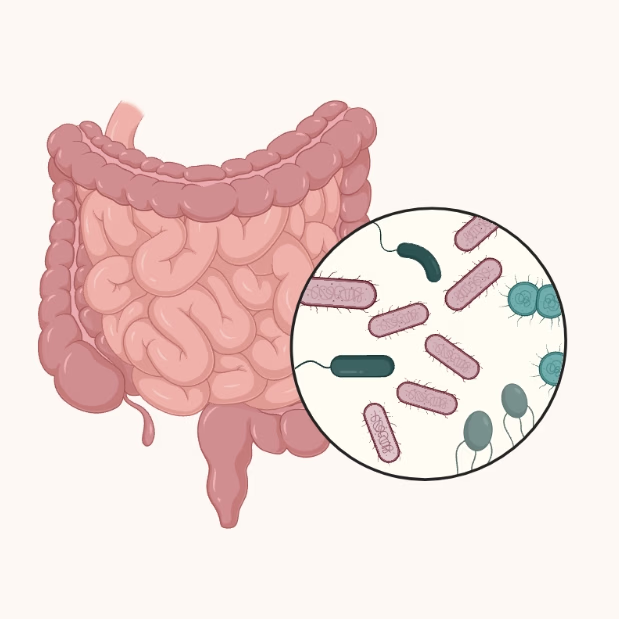
In this context, the gut microbiome has emerged as an potential target. A growing body of evidence suggests that the gut microbiome is not only associated with PMOS, but may also play a functional role in steroid metabolism and androgen regulation. Microbial steroidSteroids are hormones built on a shared four-ring skeleton, e.g. testosterone and oestrogen. Enzymes can change their shape and activity.-modifying enzymes can reshape intestinal pools of androgens and related metabolites, and recent studies indicate that these activities may also influence circulating androgen levels, suggesting that microbial steroid metabolism may contribute to systemic androgen tone (Hsiao et al., 2023; Veerus et al., 2026; Ohlsson et al., 2025).
Testosterone and related androgens are produced endogenously by the ovaries, adrenal glands, and peripheral tissues, and circulate in blood either bound to proteins such as SHBG and albumin or in a free bioactive fraction. The liver plays a central role in androgen metabolism, where steroid hormones undergo reactions (phase I and phase IIPhase I reactions chemically alter a molecule, e.g. by adding oxygen. Phase II reactions attach a bulky group to it, making it easier to excrete.) that increase their polarity and facilitate excretion (Veerus et al., 2026).
- Phase I metabolism, includes reaction to increase polarity;
- Phase II metabolism (conjugation), including glucuronidationThe liver attaches a sugar acid to a hormone, making it water-soluble so it can be excreted. and sulfation.The liver attaches a sulfate group to a hormone, making it water-soluble so it can be excreted.
These two phases combined generates more hydrophilic androgen metabolites that can be eliminated through urine or secreted into bile and delivered to the intestine.
However, conjugated steroids entering the gut lumenThe inside space of the intestine, where food and microbes are. are not necessarily irreversibly eliminated. Microbial enzymes can deconjugateRemove the group the liver attached, which can turn the hormone back into its active form. and chemically transform these molecules, potentially regenerating bioactive steroids or producing new steroid metabolites that may be reabsorbed into circulation through enterohepatic recirculationSubstances released from the liver into the gut via bile are reabsorbed and carried back to the liver, instead of leaving the body. (Veerus et al., 2026).
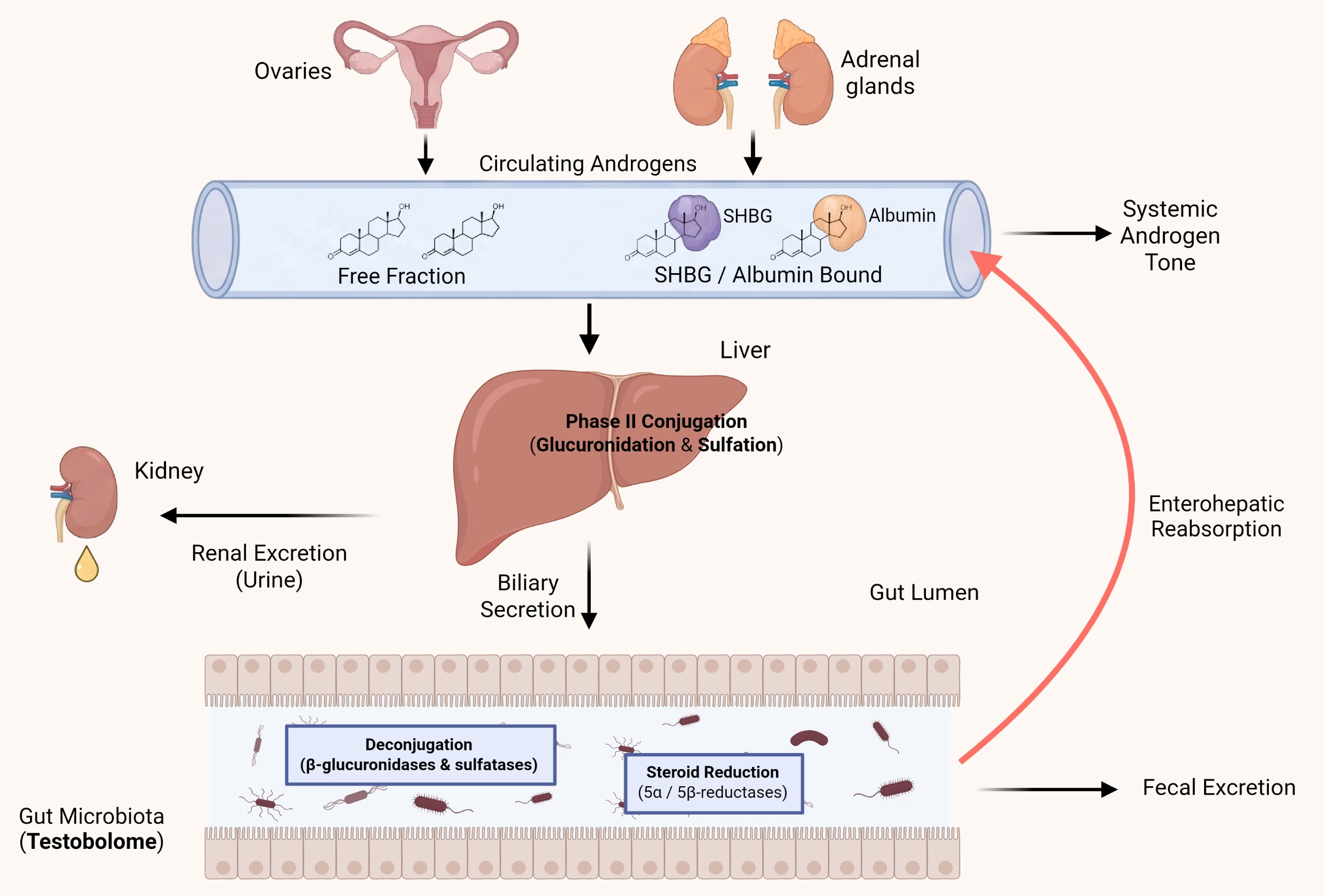
The Testobolome
The concept of the “Testobolome” has recently been proposed by Veerus et al., 2026 to describe gut microbes and microbial genes involved in testosterone metabolism. The testobolome includes different microbial enzymes such as steroid reductases that can catalyze structural modifications of the steroid A-ringThe first of the steroid's four rings, where the key changes to testosterone's activity happen., including 5α-reduction and 5β-reductionTwo ways enzymes add hydrogen to the first ring of a steroid. The two products have different shapes, and the 5β form barely activates the androgen receptor.. These reactions may alter androgen receptorThe protein in cells that androgens bind to in order to have their effect. activity, steroid stability, and the likelihood of reabsorption.
AnTigone question

If intestinal microbial activities contribute to the regeneration, persistence, or structural conversion of androgenic metabolites, then the gut may represent a previously underexplored site for localized intervention. Most current PMOS treatments act systemically and are not designed to modulate intestinal steroid metabolism directly. This creates an opportunity for synthetic biology approaches aimed at engineering controllable, localized systems capable of modifying steroid bioactivity within the gut environment.
References
- Gao, Y., Liu, C., & He, X. (2026). The impact of gut microbiota on insulin resistance in polycystic ovary syndrome: Mechanisms and therapeutic prospects. Frontiers in Cellular and Infection Microbiology, 16, 1840605. https://doi.org/10.3389/fcimb.2026.1840605
- Gibson-Helm, M., Teede, H., Dunaif, A., & Dokras, A. (2017). Delayed diagnosis and a lack of information associated with dissatisfaction in women with polycystic ovary syndrome. The Journal of Clinical Endocrinology & Metabolism, 102(2), 604–612. https://doi.org/10.1210/jc.2016-2963
- Harrath, A. H., Jalouli, M., Al-Zharani, M., & Rahman, M. A. (2026). Modern polycystic ovary syndrome (PCOS) management: Intelligent drug delivery and metabolic reprogramming for ovarian restoration and fertility optimization. Biomolecules, 16(5), 626. https://doi.org/10.3390/biom16050626
- Helvaci, N., & Yildiz, B. O. (2025). Polycystic ovary syndrome as a metabolic disease. Nature Reviews Endocrinology, 21, 230–244. https://doi.org/10.1038/s41574-024-01057-w
- Hsiao, T. H., Chou, C. H., Chen, Y. L., Wang, P. H., Brandon-Mong, G. J., Lee, T. H., Wu, T. Y., Li, P. T., Li, C. W., Lai, Y. L., Tseng, Y. L., Shih, C. J., Chen, P. H., Chen, M. J., & Chiang, Y. R. (2023). Circulating androgen regulation by androgen-catabolizing gut bacteria in male mouse gut. Gut Microbes, 15(1), 2183685. https://doi.org/10.1080/19490976.2023.2183685
- Li, P., Shuai, P., Shen, S., Zheng, H., Sun, P., Zhang, R., Lan, S., Lan, Z., Jayawardana, T., Yang, Y., Zhao, J., Liu, Y., Chen, X., El-Omar, E. M., & Wan, Z. (2023). Perturbations in gut microbiota composition in patients with polycystic ovary syndrome: A systematic review and meta-analysis. BMC Medicine, 21(1), 302. https://doi.org/10.1186/s12916-023-02975-8
- Ohlsson, C., Li, L., Horkeby, K., Lawenius, L., Colldén, H., Sjögren, K., Baldanzi, G., Engström, G., Ärnlöv, J., Orho-Melander, M., Fall, T., & Grahnemo, L. (2025). The circulating dihydrotestosterone/testosterone ratio is increased by gut microbial 5α-reductase activity in females. EBioMedicine, 121, Article 105978. https://doi.org/10.1016/j.ebiom.2025.105978
- Rotterdam criteria for diagnosing polycystic ovarian syndrome (PCOS). (2017, July 13). Time of Care. https://www.timeofcare.com/rotterdam-criteria-for-diagnosing-polycystic-ovarian-syndrome-pcos/
- Swedish Agency for Health Technology Assessment and Assessment of Social Services (SBU). (n.d.). Läkemedelsbehandling av polycystiskt ovarialsyndrom – hälsa och livskvalitet på kort och lång sikt. Retrieved March 25, 2026, from https://www.sbu.se/394
- Teede, H. J., Khomami, M. B., Morman, R., Laven, J. S. E., Joham, A. E., Costello, M. F., Patil, M., Rees, D. A., Berry, L., Cree, M. G., Zhao, H., Norman, R. J., Dokras, A., Piltonen, T., Amao, S., Amiri, M., Andrews, C., Arcari, A., Arlt, W., . . . Zhang, Y. (2026). Polyendocrine metabolic ovarian syndrome, the new name for polycystic ovary syndrome: A multistep global consensus process. The Lancet, 407(10545), 2329–2339. https://doi.org/10.1016/s0140-6736(26)00717-8
- Teede, H. J., Tay, C. T., Laven, J. J. E., Dokras, A., Moran, L. J., Piltonen, T. T., Costello, M. F., Boivin, J., Redman, L. M., Boyle, J. A., Norman, R. J., Mousa, A., & Joham, A. E. (2023). Recommendations from the 2023 international evidence-based guideline for the assessment and management of polycystic ovary syndrome. The Journal of Clinical Endocrinology & Metabolism, 108(10), 2447–2469. https://doi.org/10.1210/clinem/dgad463
- Torres, P. J., Siakowska, M., Banaszewska, B., Pawelczyk, L., Duleba, A. J., Kelley, S. T., & Thackray, V. G. (2018). Gut microbial diversity in women with polycystic ovary syndrome correlates with hyperandrogenism. The Journal of Clinical Endocrinology & Metabolism, 103(4), 1502–1511. https://doi.org/10.1210/jc.2017-02153
- Veerus, L., Subrahmanian, A., & Blaser, M. J. (2026). The testobolome in microbial testosterone metabolism and human health. npj Biofilms and Microbiomes, 12, Article 9. https://doi.org/10.1038/s41522-025-00861-0
- Wang, K., Li, Y., & Chen, Y. (2023). Androgen excess: A hallmark of polycystic ovary syndrome. Frontiers in Endocrinology, 14, 1273542. https://doi.org/10.3389/fendo.2023.1273542
- World Health Organization. (2026, January 22). Polycystic ovary syndrome [Fact sheet]. https://www.who.int/news-room/fact-sheets/detail/polycystic-ovary-syndrome